



Good summer ventilation is not simply about having more windows. The way a window opens, the amount of usable opening it provides, its location in the room, and the direction it faces all affect how much air can move through the home.
Some windows open wide and help catch passing breezes. Others provide smaller, more controlled ventilation while maintaining privacy or protection from light rain. The best solution often involves using different window styles in different parts of the house.
Natural Resources Canada recommends opening windows at night when the outdoor temperature is cooler, while keeping windows and coverings closed during the hottest parts of the day. The right operable windows make this strategy much easier to use effectively.
What Makes a Window Good for Summer Ventilation?
When comparing window styles, homeowners often focus on appearance, glass size, colour, and energy efficiency. These are important considerations, but the operating style also deserves attention.
A window that provides effective summer ventilation should offer a useful combination of:
- A large enough opening to move air
- Control over how far the window opens
- The ability to catch or direct a breeze
- Convenient operation and cleaning
- Appropriate safety and security features
- A strong seal when the window is closed
The best-performing style also depends on where the window will be installed. A casement window that works beautifully in a second-floor bedroom may not be practical beside a narrow walkway. An awning window may be ideal above a kitchen counter, while a sliding window may be more suitable for a wide basement opening.
There is no single style that is automatically best for every room. The goal is to match the window’s operation to the size, location, and ventilation needs of the space.
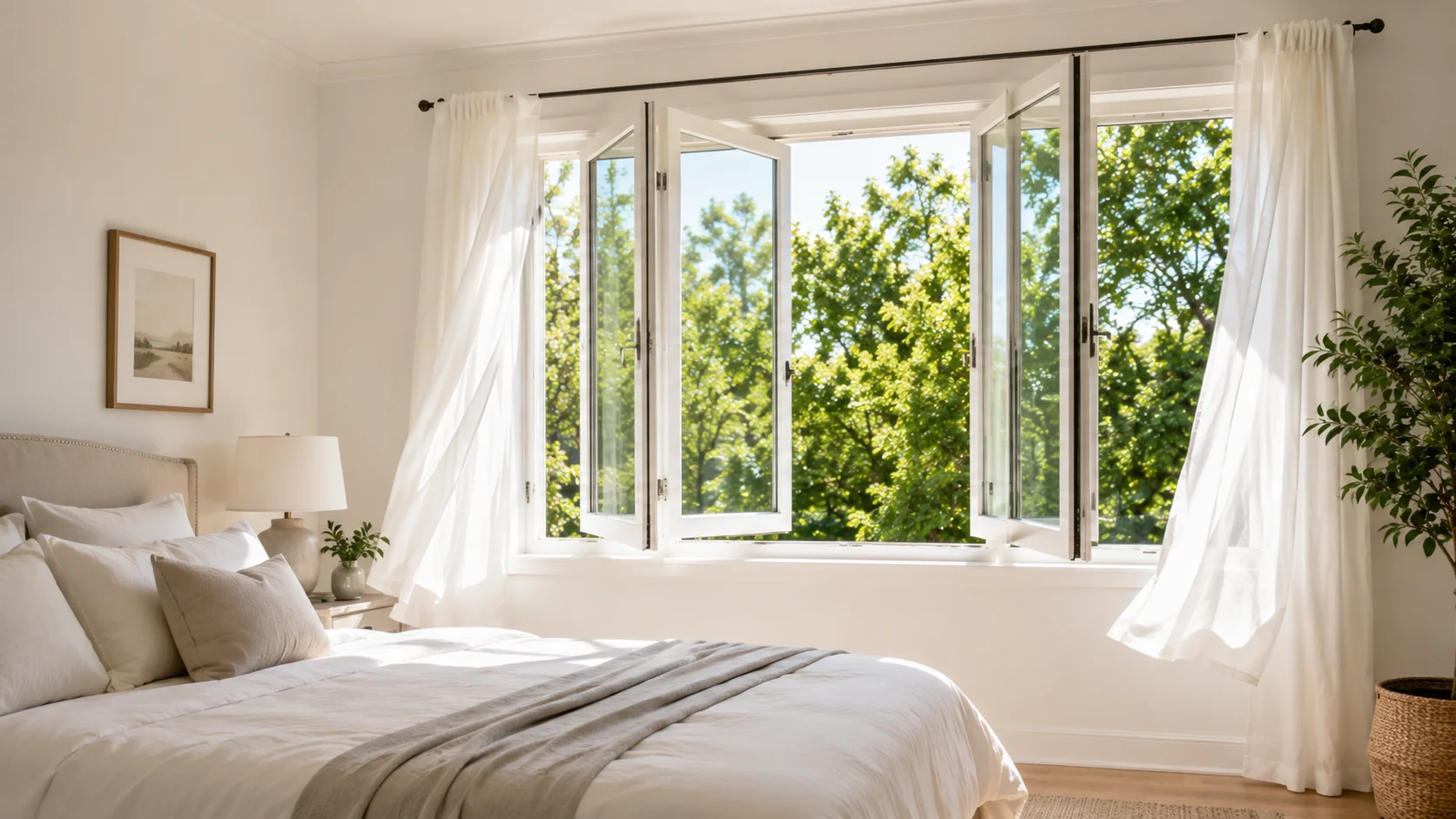
1. Casement Windows: Best Overall for Strong Airflow
For homeowners who want to maximize natural airflow, casement windows are often the strongest option.
A casement window is hinged on one side and opens outward using a crank. Because most of the sash moves away from the frame, the window can create a large, unobstructed opening. AZTech casement windows can open as far as 90 degrees, providing substantial ventilation when conditions are suitable.
The outward-opening sash can also act like a scoop. When the window is positioned correctly in relation to the wind, it can catch a passing breeze and direct it into the room. This makes casement windows especially useful in bedrooms, living rooms, dining rooms, and other areas where stronger airflow is preferred.
Where Casement Windows Work Best
Casement windows are well suited to:
- Bedrooms that become warm overnight
- Living and family rooms
- Kitchens with accessible window openings
- Upper floors where warm air tends to collect
- Rooms with limited natural airflow
They are also a practical choice when homeowners want a wide view with relatively little interruption from the frame.
However, exterior clearance must be considered. Because casement windows swing outward, they may not be appropriate beside a busy walkway, directly above a deck, or in another location where the open sash could create an obstruction.
Casement hardware and screens should also be kept clean and maintained so the sash continues to open smoothly and close tightly.
2. Tilt and Turn Windows: Best for Flexible and Controlled Ventilation
Tilt and turn windows offer two distinct opening positions.
When the handle is turned one way, the top of the sash tilts inward, creating a smaller opening along the top and sides. When the handle is moved to the second position, the window swings inward like a door and creates a much larger opening.
This dual operation gives homeowners more control over summer ventilation.
The tilt position is useful when only a modest amount of fresh air is needed. It can help reduce the feeling of a closed or stuffy room without opening the entire window. The full turn position can then be used when the outdoor temperature drops and stronger airflow is desirable.
Where Tilt and Turn Windows Work Best
Tilt and turn windows can be a strong choice for:
- Second-storey bedrooms
- Home offices
- Urban properties
- Rooms facing busy outdoor areas
- Homes where controlled ventilation is important
- Openings where easy interior cleaning is preferred
Because the sash opens inward in the full turn position, the room needs enough interior clearance. Homeowners must also consider blinds, curtains, furniture, and other items that could interfere with the sash.
Tilt and turn windows are generally more complex than standard North American window styles. Their heavier frames and advanced hardware may also affect the project cost. However, their combination of controlled ventilation, broad opening capacity, and interior cleaning access can make them a valuable option for the right home.
3. Double-Hung Windows: Best for Natural Vertical Air Circulation
Double-hung windows have two movable sashes. The lower sash can be raised, while the upper sash can be lowered.
Opening both sections can support a simple form of vertical air circulation. When indoor air is warmer than the air outside, warm air can leave through the upper opening while cooler air enters through the lower opening.
This makes double-hung windows especially useful on upper floors, where heat often collects during the summer.
AZTech’s double-hung windows allow homeowners to open either the top or bottom section, or partially open both, depending on how much ventilation is needed.
Double-Hung vs. Single-Hung Windows
A single-hung window typically has one movable lower sash and one fixed upper sash. It can still provide ventilation, but it offers less flexibility than a double-hung window.
A double-hung window may be preferred when:
- Ventilation is a major priority
- The window is located on an upper floor
- Homeowners want to open the upper sash
- Interior cleaning access is important
- The home has a traditional architectural style
Opening the upper sash may also be more practical in certain rooms where furniture or household activity makes the lower portion less convenient. Any operable window used around children or pets should still have appropriate locks, opening controls, and adult supervision.
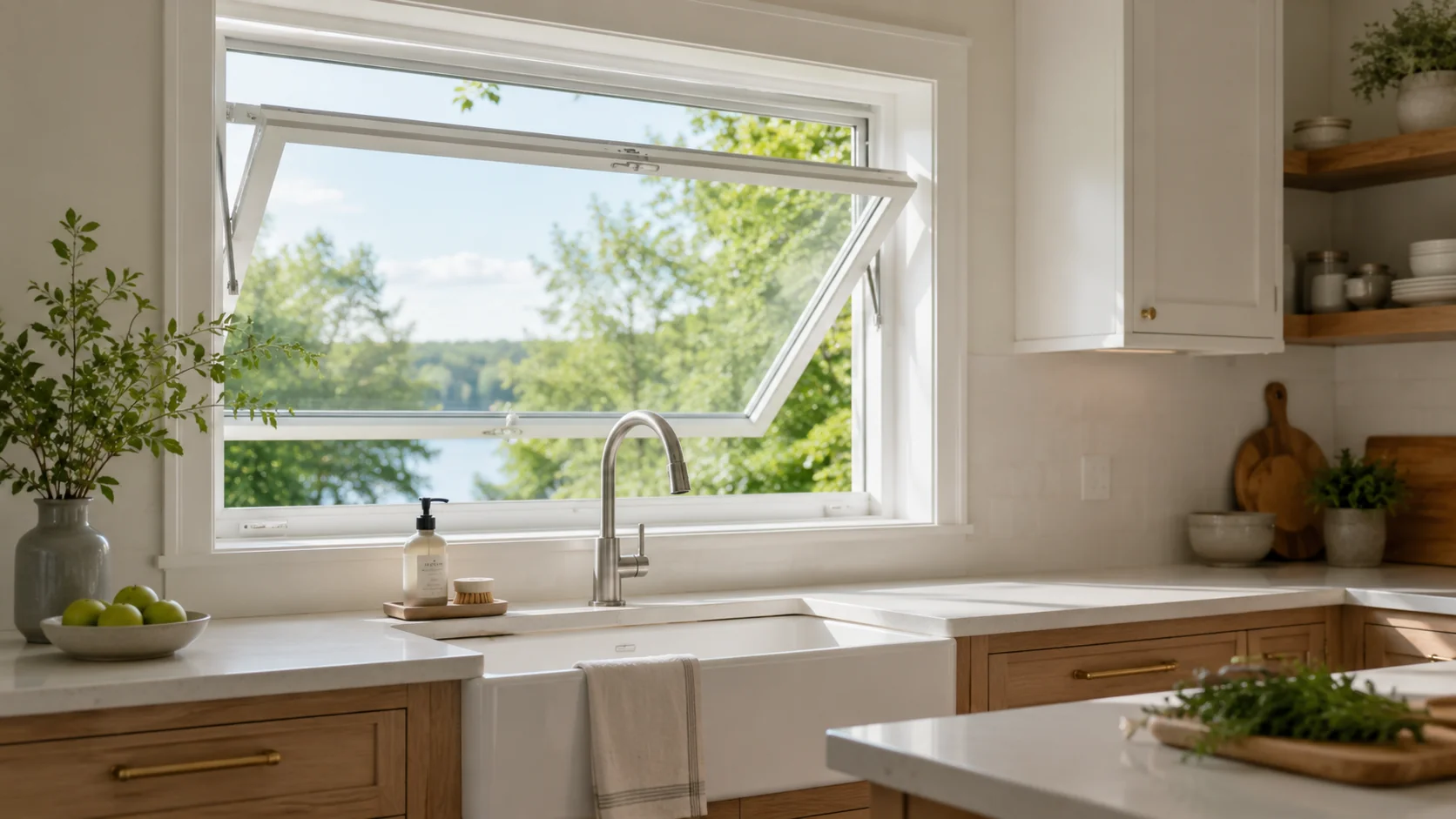
4. Awning Windows: Best for Ventilation During Light Rain
Awning windows are hinged at the top and open outward from the bottom. When opened, the glass sash creates a small canopy over the opening.
This design allows homeowners to maintain some ventilation during light rain, although windows should still be closed during heavy rain, strong wind, or severe weather.
AZTech awning windows open outward up to approximately 45 degrees and are commonly used in openings that are wider than they are tall.
Where Awning Windows Work Best
Awning windows are particularly useful in:
- Kitchens
- Bathrooms
- Basements
- Laundry rooms
- Openings located higher on a wall
- Rooms where privacy and ventilation are both important
They are often installed above kitchen counters or sinks because the crank and locking hardware can remain accessible even when the bottom of the window is difficult to reach.
Awning windows can also be positioned above or below a larger fixed window. This combination preserves a broad glass area while adding an operable section for airflow.
The amount of ventilation is generally more controlled than what a fully opened casement window provides. For a room that needs maximum airflow, a casement window may be the better choice. For a room where weather protection and convenience matter more, an awning window may be more practical.
5. Sliding Windows: Best for Wide Openings and Limited Clearance
Sliding windows open horizontally along a track. They do not project into the room or swing outward from the exterior wall.
This makes them useful where there is limited clearance, including areas beside decks, stairs, patios, walkways, and outdoor living spaces.
Sliding windows are commonly installed in openings that are wider than they are tall. A single slider has one operable sash, while a double slider allows both sections to move. AZTech also offers end-vent slider configurations for wider openings.
Where Sliding Windows Work Best
Sliding windows are often suitable for:
- Basements
- Family rooms
- Wide bedroom openings
- Areas beside decks or walkways
- Rooms where simple operation is preferred
- Locations where an outward-opening sash would be inconvenient
A double slider generally provides more ventilation flexibility than a single slider because both sides can be opened.
However, a sliding window usually exposes only part of the total window area at one time. It may not capture and direct breezes as effectively as a casement window. Tracks must also be kept clean so the sash can move easily and close properly.
6. Fixed and Operable Window Combinations: Best for Views and Ventilation
Fixed windows do not open, so they cannot ventilate a room on their own. Their purpose is to provide natural light, outdoor views, and a clean appearance.
That does not mean they should be excluded from a ventilation-focused window design.
A large fixed window can be combined with smaller casement or awning windows. This allows the homeowner to preserve a broad view while adding operable sections where airflow is most useful.
For example, a large fixed window in a living room could be installed between two casement windows. When the side windows are opened, they can help bring fresh air into the room without dividing the central view into several smaller panes.
Similar combinations can be used in bay and bow windows. Operable side sections can provide ventilation while the larger fixed sections add light and dimension to the room.
Summer Ventilation Comparison
| Window Style | Ventilation Potential | Best Applications | Main Consideration |
|---|---|---|---|
| Casement | Excellent | Bedrooms, living rooms and kitchens | Requires exterior clearance |
| Tilt and turn | Excellent and adjustable | Upper floors, offices and urban homes | Requires interior clearance |
| Double-hung | Very good | Bedrooms and traditional homes | Both sashes must operate properly |
| Awning | Good | Kitchens, bathrooms and basements | Smaller opening than most casements |
| Sliding | Moderate to very good | Wide openings and areas with limited clearance | Only part of the opening may be exposed |
| Fixed | None on its own | Feature windows and large views | Must be paired with an operable style |
Choosing the Right Window Style for Each Room
The same window style does not need to be used throughout the entire house. In many cases, combining styles produces better comfort and functionality.
Living Rooms and Family Rooms
Casement windows are often a good choice for living areas because they can open widely and help direct outdoor air into the room.
For a wider wall, a large fixed window with operating casements on either side can create a balanced combination of natural light, views, and ventilation.
Sliding windows may be preferable when the room faces a deck, patio, or walkway where an outward-opening sash would interfere with movement.
Kitchens
Kitchens benefit from windows that are easy to operate and can release heat created by cooking.
Awning windows are commonly used above sinks and counters because the operating hardware is positioned near the bottom of the frame. Casement windows can also provide strong airflow when the opening is easy to reach.
An operable window should complement, not replace, a properly functioning kitchen exhaust system. Cooking moisture, odours, and airborne particles should still be managed with appropriate mechanical ventilation.
Bedrooms
Casement, double-hung, and tilt and turn windows can all work well in bedrooms.
Casement windows provide a large opening, while double-hung windows offer adjustable top and bottom ventilation. Tilt and turn windows allow homeowners to choose between a smaller tilted opening and a full inward opening.
Bedroom windows must also satisfy any applicable safety and emergency-exit requirements. Measurements, opening configurations, and local building requirements should be reviewed before selecting a replacement style.
Bathrooms
Bathrooms often need a balance of ventilation, privacy, and moisture management.
Awning windows are a practical option because they can be installed higher on the wall and opened during light rain. Privacy glass can be added where appropriate.
As with kitchens, an operable bathroom window should not be treated as a replacement for an exhaust fan. The fan helps remove moisture consistently, including during periods when outdoor humidity is high or the window needs to remain closed.
Basements
Sliding and awning windows are frequently used in basements because the openings are often wider than they are tall.
A slider can provide a practical opening without projecting into a window well. An awning window may be suitable where the exterior space allows the sash to open safely.
Basement bedrooms require additional consideration. The window style, clear opening, window well, and installation must comply with applicable requirements for emergency exit.
Window Placement Matters as Much as Window Style
Even a highly operable window will provide limited ventilation if it is poorly positioned.
The most effective natural airflow usually happens when air has a clear route into and out of the home. Opening windows on opposite sides of a room or on different sides of the house can create cross-ventilation.
For example, a breeze may enter through a casement window on one side of the house and push warmer indoor air toward an open window on the opposite side.
Windows installed at different heights can also help move air. Warmer air tends to rise, so an upper opening can give it a place to escape while a lower opening allows cooler air to enter.
The direction of the window matters as well. A casement window facing a common breeze may capture more air than the same window installed on a sheltered wall. Nearby fences, trees, neighbouring homes, and additions can all affect airflow.
A professional window assessment should therefore consider the entire room and exterior environment, not just the dimensions of the existing frame.
How to Use Your Windows More Effectively During an Ontario Summer
Opening every window throughout the day is not always the best way to keep a home cool.
On hot days, outdoor air may be warmer than the air inside. Opening the windows can bring additional heat and humidity into the house, especially when the air conditioner is running.
Natural Resources Canada recommends keeping the home closed during hot daytime periods and using natural or forced ventilation at night when the outdoor air becomes cooler. Closing blinds or curtains during periods of direct sunlight can also reduce heat entering through the glass.
A practical routine may include:
- Keeping windows and coverings closed during the hottest part of the day.
- Checking the outdoor temperature in the evening.
- Opening windows on more than one side of the home once the outdoor air becomes cooler.
- Using ceiling or portable fans to help move air through occupied rooms.
- Closing the windows again in the morning before outdoor temperatures rise.
Outdoor air quality must also be considered. Health Canada advises keeping windows closed when outdoor air quality is poor, including during wildfire smoke events or periods of extreme heat. Homeowners can check the Air Quality Health Index before relying on outdoor air for ventilation.
Do Not Overlook Energy Efficiency
A window’s summer performance is not limited to how well it opens.
For much of the day, the windows may need to remain closed to keep outdoor heat and humidity from entering the home. During those periods, the quality of the glass, frame, seals, weatherstripping, and installation becomes especially important.
Energy-efficient windows can help keep conditioned air inside while reducing unwanted heat transfer through the glass and frame. Natural Resources Canada reports that ENERGY STAR certified windows are approximately 20 percent more energy efficient than average windows.
When comparing replacement windows, homeowners should consider:
- Air leakage performance
- Low-emissivity glass coatings
- Double-pane or triple-pane glazing
- Insulated frames
- Solar heat gain
- Window orientation
- Professional installation
Low-E glass can help limit the amount of infrared and ultraviolet energy passing through the window while still allowing visible light into the room. This can improve summer comfort, particularly in rooms with strong south-facing or west-facing sunlight.
The best summer window is therefore one that provides effective airflow when open and a strong, energy-efficient seal when closed.
Which Window Style Is Best for Your Ontario Home?
For maximum ventilation, casement windows are often the leading option. Their wide opening and ability to catch a breeze make them suitable for many living spaces and bedrooms.
Tilt and turn windows offer the most flexibility, allowing homeowners to choose between controlled ventilation and a larger opening. Double-hung windows are effective for vertical air circulation, especially on upper floors.
Awning windows are valuable in kitchens, bathrooms, and basements where ventilation may still be needed during light rain. Sliding windows work well in wide openings and locations where there is not enough space for an outward-opening sash.
In many homes, the best approach is a combination. The layout, window orientation, exterior clearance, room use, safety requirements, and overall design should all influence the final choice.
Homeowners planning a window replacement project can use the AZTech window replacement cost calculator to explore different window styles and prepare an initial project estimate.
AZTech Doors & Windows provides custom window replacement and professional installation throughout Toronto and the Greater Toronto Area. Our team can help you compare ventilation, energy efficiency, appearance, operation, and long-term performance so each room receives the most appropriate window style.
Contact AZTech Doors & Windows to schedule a consultation and find the right windows for a cooler, more comfortable Ontario home.