



For some homes, the issue is not only the location. It is the windows.
Older windows, thin glass, loose frames, weak seals, and poor installation can allow more outdoor sound to enter your home. Even if the window looks fine from the outside, it may not be doing enough to reduce noise.
Soundproof windows, or more accurately noise-reducing windows, are designed to lower the amount of outside sound that passes into your home. They do not make a house completely silent, because no window can block every sound. But the right window system can make a noticeable difference in daily comfort.
For Toronto homeowners, that can mean a quieter bedroom, a calmer living room, a more peaceful home office, and less street noise entering the house throughout the day and night.
Why Street Noise Is Such a Common Problem in Toronto
Toronto has many types of residential neighbourhoods. Some homes sit on quiet side streets. Others are directly exposed to heavy traffic, transit, restaurants, delivery vehicles, construction, and pedestrian activity.
Street noise is especially common near:
- Major roads and intersections
- Streetcar and bus routes
- The Gardiner Expressway
- The Don Valley Parkway
- Downtown and midtown neighbourhoods
- Mixed residential and commercial streets
- School zones and playgrounds
- Construction-heavy areas
- Condo and townhouse developments
- Laneways and rear parking areas
The City of Toronto noise bylaw page shows how many different noise sources the city has to manage, including construction noise, power devices, motor vehicles, loading and unloading, and stationary sources like air conditioners and generators.
That tells us something important: urban noise is not one single problem. It comes from many directions and many sources.
For homeowners, this means the solution often starts with the parts of the home where sound enters most easily. Windows are one of the biggest areas to review.
How Sound Enters Through Windows
Sound travels as vibrations through air and materials. When noise from outside reaches your home, it can pass through the glass, the frame, small gaps around the window, and weak seals.
This is why some homes feel louder than others, even if they are on the same street.
Noise can enter through:
- Thin or older glass
- Single-pane windows
- Loose window sashes
- Poor weatherstripping
- Cracks around the frame
- Gaps between the window and wall opening
- Old caulking
- Poorly fitted storm windows
- Older sliding windows that do not seal tightly
- Patio doors with large glass areas
A window is not only glass. It is a full system. If the glass is strong but the frame leaks air, sound can still get through. If the frame is solid but the installation has gaps, noise can still enter around the opening.
This is why professional window replacement can make such a difference. The goal is not only to replace the visible window. The goal is to improve the full opening so the home has a stronger barrier against outside noise.
Soundproof vs. Noise-Reducing Windows
The term “soundproof windows” is commonly used, but it can be a little misleading.
A truly soundproof window would block all outside noise. In real homes, that is not realistic. Even high-performance windows reduce noise, but they do not remove every sound completely.
A better term is noise-reducing windows.
Noise-reducing windows are designed to lower the amount of sound that enters the home. The improvement depends on several things:
- The type of glass
- The number of panes
- The thickness of each pane
- The space between panes
- Whether laminated glass is used
- The quality of the frame
- The quality of the seals
- The quality of installation
- The type of noise outside
For example, reducing everyday traffic noise may be easier than reducing low-frequency rumbling from trucks or loud bass from vehicles. Different types of sound behave differently, so the right window setup matters.

Why Noise Reduction Matters for Home Comfort
Outside noise is not just annoying. It can affect how comfortable your home feels.
Health Canada explains that scientists use A-weighted decibels, or dBA, to describe how loud a sound is to humans. Health Canada also notes that noise exposure can affect hearing, tinnitus, mental health, and well-being depending on how loud the sound is and how long someone is exposed to it.
Health Canada also explains in its page on noise and mental health and well-being that unwanted sound can lead to annoyance, stress, and sleep disturbance. It notes that sounds can disturb sleep by making it harder to fall asleep, stay asleep, or avoid waking earlier than intended.
This matters for Toronto homeowners because street noise often happens at the worst times: early morning, late evening, overnight, or during work-from-home hours.
A quieter home can help with:
- Better sleep
- Less stress
- Better focus while working
- More comfortable family time
- Quieter bedrooms
- Better enjoyment of living rooms and offices
- Less need to turn up the TV or music
- A calmer indoor environment
You cannot control every sound outside your home. But you can improve how much of that sound gets inside.
What Makes a Window Better at Reducing Noise?
Noise-reducing windows work by making it harder for sound vibrations to pass through the glass and frame.
Several features can improve sound control.
| Window Feature | How It Helps Reduce Noise |
|---|---|
| Thicker glass | Adds mass, which helps reduce sound transmission |
| Different glass thicknesses | Helps disrupt sound vibrations |
| Laminated glass | Uses an interlayer that helps dampen sound |
| Double or triple glazing | Adds more layers for sound to pass through |
| Wider air space between panes | Can improve sound reduction in some designs |
| Tight compression seals | Reduces air gaps where sound can leak through |
| Quality frames | Helps limit vibration and leakage |
| Professional installation | Prevents gaps around the window opening |
The National Research Council Canada has published research on sound transmission through windows. The research explains that sound transmission loss measures noise reduction in decibels for specific frequency ranges, and that Sound Transmission Class, or STC, is commonly used in North America as a single-number rating for sound transmission.
In plain language, better window design can reduce how much sound passes through the window. But sound reduction is not based on one feature alone. It depends on the full window system.
Understanding STC Ratings in Plain English
STC stands for Sound Transmission Class. It is a rating used to compare how well a material or building element reduces airborne sound.
A higher STC rating generally means better sound reduction.
For homeowners, the exact number is less important than understanding the idea. A window with better sound-control features can reduce more noise than a basic window with thin glass and weak seals.
However, STC is not perfect for every type of outdoor noise.
The National Research Council Canada’s research on sound transmission through windows notes that STC is generally useful for ranking noise reduction from sources such as human voices, but it does not fully rate insulation against sources with strong low-frequency content. Many outdoor noise sources, including road traffic and aircraft, include lower-frequency sound.
That means homeowners should not choose windows based only on one number. The type of noise matters.
For example:
| Noise Source | What Homeowners Usually Notice |
| Regular traffic | Constant background hum |
| Trucks and buses | Lower rumbling sounds |
| Motorcycles | Sharp bursts of sound |
| Sirens | High, sudden noise |
| Construction | Impact sounds, engines, machinery |
| Streetcars | Rolling, braking, and track noise |
| People outside | Voices, shouting, late-night activity |
The best window choice depends on what kind of noise you are trying to reduce.
Why Laminated Glass Can Help With Street Noise
Laminated glass is often used in noise-reducing window designs.
It is made with two layers of glass bonded around a special interlayer. That interlayer helps dampen vibrations, making it harder for sound to pass through the glass.
This can be especially helpful for homes near:
- Busy roads
- Streetcar routes
- Schools
- Commercial streets
- Construction-heavy areas
- Downtown neighbourhoods
- Main-floor bedrooms
- Home offices facing the street
Laminated glass can also offer added benefits, such as improved security and UV protection, depending on the product.
For Toronto homeowners, laminated glass may be worth discussing during the window selection process, especially for front-facing windows or rooms where quiet matters most.
Double-Pane and Triple-Pane Windows for Noise Reduction
Many homeowners assume that triple-pane windows are always better for noise reduction than double-pane windows. Sometimes they are, but not always.
Triple-pane windows can help because they add another layer of glass. But sound reduction depends on the full design. Glass thickness, spacing, laminated glass, seals, and installation all matter.
A well-designed double-pane window with the right glass package may perform better for certain noise issues than a basic triple-pane window.
Here is a simple comparison:
| Window Type | Noise Reduction Potential | Best Use |
| Basic double-pane | Moderate improvement over older windows | General home comfort |
| Double-pane with laminated glass | Stronger noise reduction | Street-facing rooms and bedrooms |
| Triple-pane | Can improve insulation and comfort | Cold-weather performance and some noise control |
| Acoustic glass package | Designed specifically for noise issues | Busy roads, transit routes, high-noise areas |
The main point: do not choose based only on the number of panes. Choose based on the problem you are trying to solve.
Why Window Seals Are Critical
Sound travels through air gaps. That means even a small leak around a window can reduce the benefit of better glass.
This is why seals are so important.
If your old windows have gaps, damaged caulking, or worn weatherstripping, outside noise can slip through. You may notice this more on windy days or at night when the rest of the house is quiet.
Signs your windows are allowing too much sound include:
- You can clearly hear conversations outside
- Traffic sounds sharp instead of muffled
- Rooms facing the street feel much louder
- You hear whistling near the window
- You feel drafts around the frame
- The window rattles when trucks pass
- Noise comes through even when the window is closed
- The window is hard to lock or does not close tightly
A proper replacement window should close firmly and seal tightly. This helps reduce both air leakage and sound leakage.
This is also why installation matters so much. A good window installed poorly can still allow sound through gaps around the frame. The product and installation need to work together.
Best Window Styles for Reducing Street Noise
Some window styles are naturally better at sealing than others.
For noise reduction, windows that close tightly are usually preferred. Casement and awning windows often perform well because they use a compression seal when closed. Sliding and hung windows can still work well, but the quality of the frame, weatherstripping, and installation becomes especially important.
Here is a simple guide:
| Window Style | Noise Reduction Notes |
| Casement windows | Often strong for sealing because they close tightly against the frame |
| Awning windows | Good option for ventilation and sealing in smaller openings |
| Fixed windows | Can perform very well because they do not open and have fewer moving parts |
| Sliding windows | Practical, but seal quality is very important |
| Hung windows | Common in older homes, but older units may allow more air and sound leakage |
For rooms where quiet is a priority, such as bedrooms and home offices, fixed windows can be a strong option when ventilation is not needed. For rooms where airflow is important, casement windows may be a better fit because they can provide ventilation while still sealing tightly when closed.
For wider openings, sliding windows can be practical, especially when the right glass and sealing system are used.
Toronto Homes That Benefit Most From Noise-Reducing Windows
Not every home needs sound-focused window upgrades. But in Toronto, many homes can benefit from them.
Noise-reducing windows are especially useful for:
- Homes near busy streets
- Houses close to TTC routes
- Properties near the Gardiner or DVP
- Homes near schools or playgrounds
- Houses near restaurants or nightlife areas
- Main-floor bedrooms
- Nurseries and children’s bedrooms
- Basement apartments facing the street
- Home offices
- Condos or townhomes close to traffic
- Homes near ongoing construction
This is where window replacement becomes more than a visual upgrade. It becomes a lifestyle upgrade.
The goal is not only to make the house look newer. The goal is to make the home feel more peaceful inside.
Noise Reduction and Energy Efficiency Can Work Together
Many of the same features that help reduce noise can also support energy efficiency.
For example:
- Better seals help reduce drafts and noise
- Multiple panes help with insulation and sound control
- Stronger frames improve comfort and performance
- Professional installation helps reduce air leakage
- Modern glass packages can improve year-round comfort
According to Natural Resources Canada, ENERGY STAR certified windows are about 20% more energy efficient than the average window, and ENERGY STAR Most Efficient windows and sliding glass doors can be up to 55% more energy efficient than average models.
That means Toronto homeowners can often improve more than one issue at the same time. Better windows can help reduce outside noise, improve summer and winter comfort, and support better overall home performance.
If the home also has an older front door, patio door, or side entrance, it may be worth reviewing door replacement options as well. Doors can let in noise just like windows, especially if the frame or weatherstripping is worn.
What Soundproof Windows Cannot Do
It is important to set realistic expectations.
Noise-reducing windows can make a home quieter, but they cannot eliminate every sound. Some noise can still come through walls, ceilings, floors, vents, doors, chimneys, and other weak points in the building.
For example, if you live beside a major roadway, new windows may reduce the sharpness and volume of traffic noise, but you may still hear some low rumble from heavy trucks.
If you live in a semi-detached home or townhouse, some sound may also come through shared walls, not only windows.
Soundproof windows work best when the windows are one of the main weak points. In many older Toronto homes, they are.
How to Know If Your Windows Are the Problem
Here is a simple test.
Stand near the window when it is closed. Listen carefully. Then move a few feet away into the room. If the noise is much louder near the glass or frame, your windows may be allowing a lot of sound into the home.
You can also look for these signs:
- Old single-pane windows
- Fog between glass panes
- Loose locks or hardware
- Rattling during wind or traffic vibration
- Cracked caulking
- Gaps around trim
- Drafts near the frame
- Windows that no longer close tightly
- Large street-facing glass areas
If several of these issues are present, replacing the windows may be the better long-term solution.
Temporary fixes like heavy curtains or draft strips may help slightly, but they do not solve the full issue if the window system itself is outdated.
Choosing the Right Windows for a Quieter Toronto Home
When choosing windows for noise reduction, homeowners should look beyond the basic style and price.
Ask about:
- Glass thickness
- Laminated glass options
- Double-pane vs. triple-pane options
- Frame construction
- Weatherstripping quality
- Installation process
- Warranty
- Energy efficiency
- Which rooms need the most noise reduction
A good window consultation should consider where the noise is coming from and which rooms are most affected.
A bedroom facing a busy road may need a stronger glass package than a kitchen facing the backyard. A home office beside a streetcar route may need a different solution than a basement window near a driveway.
This room-by-room thinking usually leads to better results.
Professional Installation Is Non-Negotiable
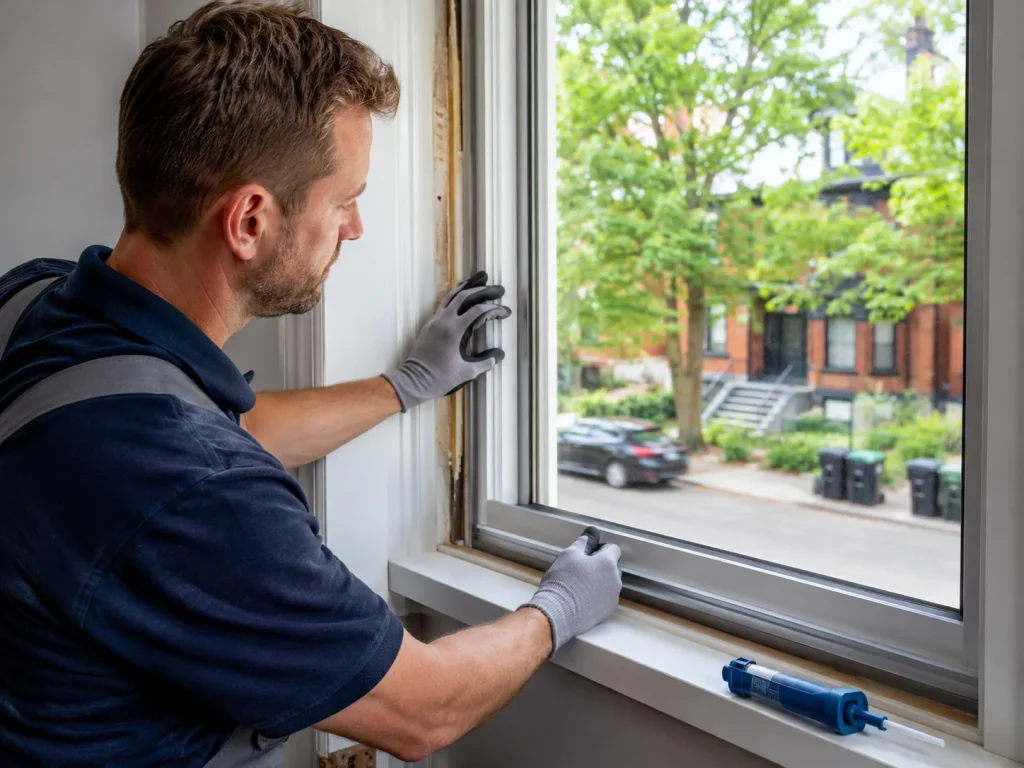
For sound reduction, installation is not a small detail. It is the difference between a good result and a frustrating one.
Even small gaps around a window can allow sound to pass through. That means the installer needs to properly fit, insulate, seal, and finish the window opening.
Professional installation helps ensure:
- The old window is removed properly
- The opening is inspected
- The new window fits correctly
- Gaps are insulated
- Seals are properly applied
- The window locks tightly
- Exterior finishing is weather-resistant
- Interior finishing is clean and secure
Toronto homes are not all built the same. Older detached houses, semis, townhomes, and renovated properties can all have different window-opening conditions. That is why local experience matters.
AZTech Doors & Windows provides window replacement services for Toronto and GTA homeowners looking to improve comfort, appearance, efficiency, and indoor quiet.
Final Thoughts: A Quieter Home Starts With Better Windows
Street noise is part of Toronto life, but it should not take over your home.
If traffic, construction, transit, neighbours, or city noise are making your home feel less comfortable, your windows may be a major part of the problem. Older glass, weak seals, poor frames, and outdated installation can all allow more sound to enter.
Soundproof windows, or more accurately noise-reducing windows, help lower outside noise by using better glass, stronger frames, tighter seals, and proper installation.
They will not make your home completely silent, but they can make it noticeably calmer.
For Toronto homeowners, that can mean better sleep, quieter evenings, improved focus, and a more peaceful home overall.